
Now booking new and returning clients

Do You Feel Like You’re Always One Step Away from Falling Apart?
Perfectionism & Anxiety Therapy for High Achievers in Ontario


On the outside, you seem to have it all together.
You’re driven, hardworking, and always pushing yourself to the next goal. People admire your success. They see the achievements, the promotions, the carefully curated life.
On the inside, it’s a different story.
Your mind never quiets. The pressure feels relentless. No matter what you accomplish, the voice in your head tells you it’s not enough. You second-guess yourself in meetings. You lie awake at night replaying conversations, wondering if you said the wrong thing. You feel like you’re constantly running, and toward what, you’re not even sure anymore.
These thoughts don’t have to control your life.
You can learn to slow down, unpack the fears that keep you stuck, and build the skills to find peace within yourself.
Does Any of This Sound Familiar?
→ You’ve reached your goals, but instead of feeling satisfied, you feel more pressure than ever.
→ You struggle to relax, always thinking about the next thing on your to-do list.
→ The fear of failure – or being exposed as a fraud – keeps you up at night.
→ You feel like you’re never doing enough, even when people tell you otherwise.
→ You crave a sense of peace, but you don’t know how to stop overthinking.
If any of this resonates, know that there’s hope. Many high-achieving adults struggle with anxiety, perfectionism, and impostor syndrome.
Together in therapy, you can work towards breaking free from these patterns and rediscovering a sense of balance and self-acceptance.

Breaking the Cycle of Anxiety and Self-Doubt
Anxiety often follows a loop – one that’s hard to recognize when you’re caught in it.
A situation triggers self-doubt. Your body tenses, your heart races, and your mind spirals with worst-case scenarios. To cope, you overwork, overthink, or avoid. The cycle repeats, reinforcing the belief that you have to keep proving yourself.
Through therapy, you can step outside this loop. Together, we’ll uncover the patterns that keep you feeling stuck and build strategies to create lasting change.
You’ll begin to:
Recognize your anxiety triggers and how they show up in your body.
Challenge self-critical thoughts that fuel impostor syndrome.
Develop coping strategies to manage stress without burning out.
Set boundaries that protect your time, energy, and well-being.
Feel at home in yourself, without needing to prove your worth.
Therapy for Perfectionism: The Double-Edged Sword
Your high standards have gotten you far, but when perfectionism turns into a fear of making mistakes, it becomes exhausting. You might spend hours refining work that’s already great, procrastinate out of fear of failing, or avoid taking risks because you’re terrified of getting it wrong.
Perfectionism can make life feel rigid and unforgiving. Let’s work together to begin to shift from an all-or-nothing mindset to one where you can strive for excellence without losing yourself in the process.
Let’s Explore Your Inner Critic?

Perfectionism vs. High Standards: What’s the Difference?
High standards are not the problem. Wanting to do meaningful work well is a strength, and it has probably served you for most of your life. Perfectionism is what happens when those standards stop being a choice and start feeling like a condition of your worth.
A simple way to tell them apart is to notice how you feel after the work is done.
High standards leave room for satisfaction. You can finish something, feel good about it, and move on.
Perfectionism moves the goalpost. The relief lasts a few hours, then your mind finds the next flaw or the next thing to prove.
High standards treat mistakes as information.
Perfectionism treats mistakes as evidence that something is wrong with you.
High standards are flexible. You can decide when “good enough” really is good enough.
Perfectionism is all or nothing. Anything less than flawless feels like failure.
The goal of therapy isn’t to lower your standards or make you care less. It’s to help you keep the drive that matters to you without the fear or shame that’s been powering it.
Signs of Perfectionism People Often Miss
Perfectionism doesn’t always look like colour-coded calendars and flawless work. Often it looks like the opposite, which is why so many high achievers don’t recognize it in themselves. You might notice:
Procrastinating on the things that matter most, because starting means risking doing it badly
Struggling to delegate or ask for help, because it feels faster and safer to do it yourself
Brushing off compliments while replaying criticism for days
Feeling like rest has to be earned, and feeling guilty when you do slow down
Avoiding new things you’re not already good at
Overpreparing for meetings, conversations, or presentations, then still feeling like you missed something
Holding others to impossible standards too, and feeling frustrated or let down when they fall short
If several of these feel familiar, it doesn’t mean something is wrong with you. It usually means perfectionism has been a strategy for staying safe, and at some point the strategy started costing more than it gives.
How Therapy Helps with Perfectionism
There isn’t one right way to work with perfectionism, so with each client I work with across Ontario, I draw on several approaches and tailor them to you.
Cognitive Behavioural Therapy (CBT)
CBT is just one of the approaches I use for perfectionism. Together we’ll identify the rules you live by (“If I make a mistake, people will see I’m not capable”), look at where they came from, and test them in small, manageable ways. Over time, those rules start to loosen.
DBT-Informed Skills
Perfectionism often comes with intense emotions: shame after a mistake, panic before a deadline, frustration when things feel out of control. DBT skills give you practical ways to ride out those waves and respond to yourself with more steadiness.
Narrative Therapy
Many perfectionists carry a story about who they have to be: the reliable one, the high achiever, the one who never drops the ball. Narrative therapy helps you step back from that story, see how it was shaped, and decide which parts you still want to keep.
Somatic and Mind-Body Work
Perfectionism lives in the body as much as the mind. Tight shoulders, a racing heart before you hit send, trouble switching off at night. Somatic and mindfulness-based practices help you notice those signals earlier and calm your nervous system, so you’re not running on adrenaline all the time.
What Therapy for Perfectionism Looks Like
I’m Samantha Charan, MSW, RSW, a Registered Social Worker providing psychotherapy to adults across Ontario who are ready to loosen perfectionism’s grip. We start with a free consultation to talk about what’s bringing you in and whether we’re a good fit. From there, our early sessions focus on understanding your patterns: where perfectionism shows up, what it protects you from, and what it’s costing you.
As we go, sessions become more active. We might map out a recent situation that sent you spiralling, practise a new way of responding to your inner critic, or try a small experiment between sessions, like sending an email without rereading it five times. The pace is always yours to set.
All sessions are virtual, so you can join from anywhere in Ontario.
Sessions start at $105, and I direct bill Green Shield Canada. Full fee and insurance details here.
Perfectionism Therapy FAQs
Is perfectionism actually treatable?
Yes. Perfectionism is a learned pattern, not a fixed personality trait, and research supports approaches like CBT for helping people loosen it. Many people notice shifts in how they respond to mistakes and self-criticism as they practise new skills in and between sessions. Everyone’s pace is different.
Will therapy make me lose my drive?
This is one of the most common worries, and it makes sense. The goal isn’t to make you care less. It’s to separate your ambition from fear and shame, so you can keep working toward what matters to you without burning out to get there.
Is perfectionism a diagnosis?
No. Perfectionism isn’t a formal diagnosis, but it often shows up alongside anxiety, burnout, impostor syndrome, and depression. You don’t need a diagnosis to benefit from therapy for perfectionism.
How do I know if it’s perfectionism or anxiety?
They overlap a lot. Perfectionism is often one of the ways anxiety shows up: the need to get everything right is a way of managing worry about what might go wrong. In therapy, we work with both, so you don’t have to sort it out on your own first.
How long does therapy for perfectionism take?
It varies. Some people come in for a focused stretch of sessions to build specific skills, and others prefer longer-term work to explore deeper patterns. We’ll talk about what makes sense for your goals and check in along the way. Because sessions are virtual, it’s easy to fit them in consistently wherever you are in Ontario, whether you’re in Toronto, Ottawa, or a smaller town without many local options.
Navigating Life Transitions Without Feeling Overwhelmed
Change – even when it's a good or exciting change – can bring anxiety. Whether you’re stepping into a new job, moving to a new city, or navigating a shift in your relationships, uncertainty can be unsettling.
If you’re feeling lost, unsteady, or unsure about your next step, therapy can offer a grounding space to explore what’s next without the weight of self-doubt holding you back.
Feel Confident About What’s Next
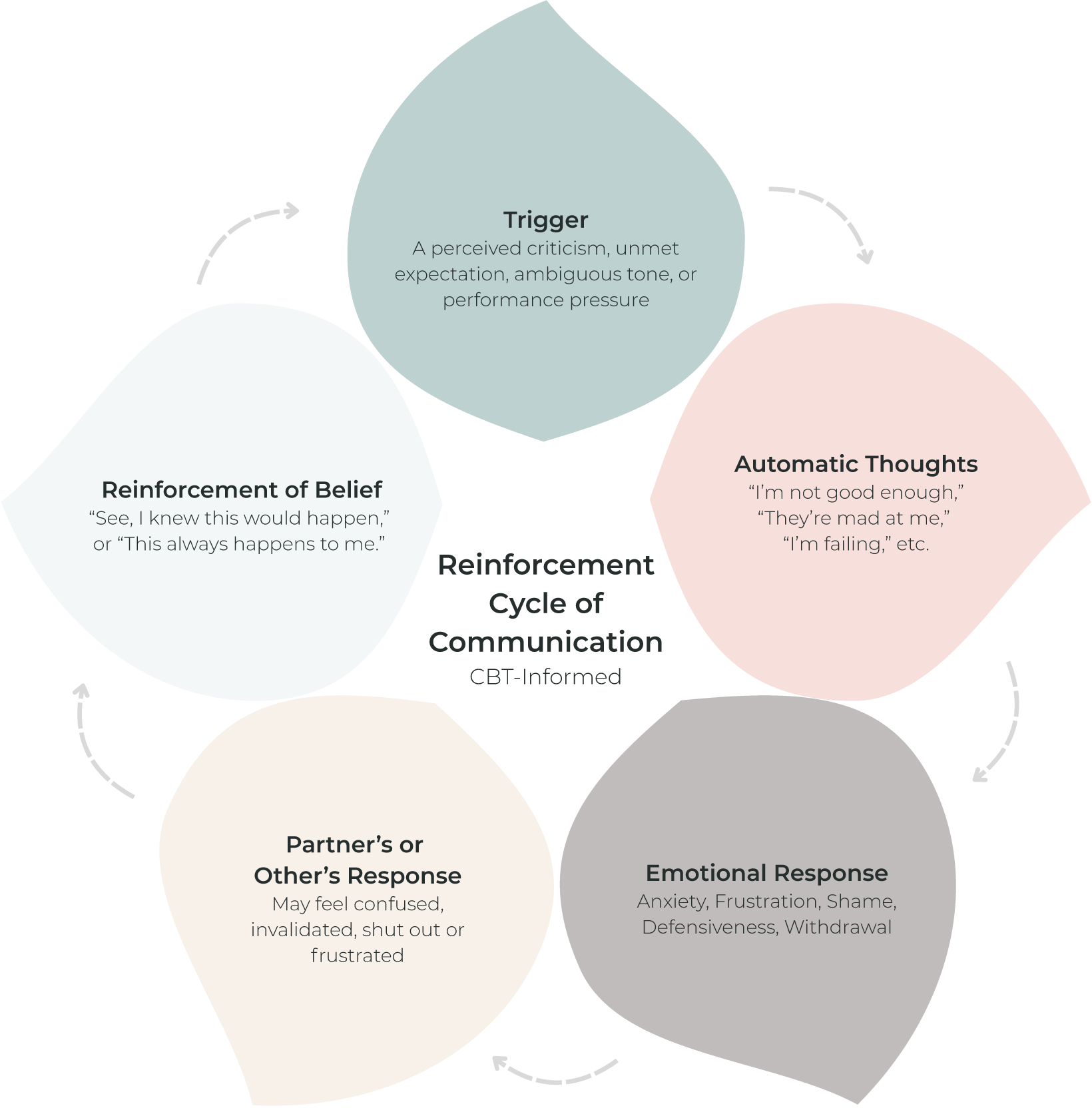
Understanding Your Reinforcement Cycle
Anxiety isn’t random. It follows a pattern: trigger, reaction, body cues, and behavioural response. You feel the pressure rising, your body reacts, and you fall into familiar habits to cope. These habits often keep you stuck. In therapy, we can unpack this cycle and find the tools to break free.
Through self-awareness and reflection, you’ll start to notice these patterns in real time. Instead of getting caught in the spiral, you’ll understand how to pause, reassess, and respond in a way that supports your well-being.

What Therapy Looks Like
Starting therapy is a brave step. It takes courage to begin to make sense of what’s going on and find a path forward that feels right for you.
Using a mix of Cognitive Behavioural Therapy (CBT), DBT-informed skills, Narrative Therapy, and somatic and mindfulness-based techniques, we’ll work together to unravel the knots of anxiety, perfectionism, relationships, and impostor syndrome.
You’ll gain tools to manage stress, rewrite the unhelpful stories you tell yourself, and build a sense of confidence that isn’t tied to external achievements.
Imagine Feeling at Peace with Yourself
Imagine waking up without the weight of anxiety pressing on your chest. Moving through your day with a sense of clarity and purpose. Feeling at home in your body instead of fighting against it. Knowing that you are enough, without constantly having to prove it.
You don’t have to keep living in the cycle of anxiety, self-doubt, and burnout. Relief is possible. Let’s see if you can start finding your way back to yourself.
Let’s Take the First Step Together.
Book a free consultation today and start your journey toward lasting relief.